Soy oligosaccharides: effect on our health
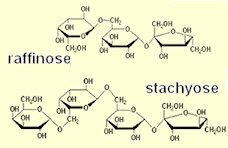 Soybeans contain raffinose (0.7%) and stachyose (3%), which are oligosaccharides with powerful prebiotic properties. But what are oligosaccharides and prebiotic sugars?
Oligosaccharides are large molecules consisting of 3 or more sugar units. They taste less sweet than monosaccharides, such as glucose or fructose, and disaccharides, such as saccharose. Prebiotic compounds are defined as nondigestible food ingredients that have beneficially effects in the host by selectively stimulating the growth and activity of health promoting bacteria, such as bifidobacteria and lactic acid bacteria, in their colon. Why would you buy expensive probiotic yoghurts, such as Yacult or Activia, when consuming soy products will achieve better effects in a more natural way.
Does soy give you gas?
Oligosaccharides from soybeans, but also from other foods such as chickpeas, sunflower seeds, onions, cabbage and other beans, are known to cause flatulence in sensitive individuals. Flatulence is not unhealthy, but passing gas in the wrong place at the wrong time can cause social embarrassment. Consuming soy products does not always give you gas, if you consume soy on a regular basis you may even experience less faltulence production, because your colon bacteria will adapt and digest the oligosaccharides into lactic acid, without gas formation. Fermented soy products, such as tempeh, soy sauce and miso, are likely to give less gas than unfermented soy products such as tofu and soy milk. If you make your own soy milk you can reduce the level of oligosaccharides in the soy milk by increasing the soaking time of the soybeans.
And what does science tell us? Fabrizis Suarez and co-workers investigated the effect of soy ingestion on gas formation in 20 healthy persons (1). They found that the intake of 34 g soy meal had no influence on either the severity of symptoms nor flatus frequency, but consuming 80 g soy meal (which is quite a lot) doubled the flatus frequency. The scientists also tested a special soybeans naturally low in oligosaccharides and found that it produced little flatulence, significantly less than that associated with conventional soy.
Health benefits of soy oligosaccharides
Our body cannot digest raffinose and stachyose very well, but "good" gut bacteria thrive on them on are responsible for many health benefits, which include:
- Stimulation of the growth of bifidobacteria, which suppress the activity of putefactivebacteria, such as Clostridium in the colon.
- Preventing constipation due to the production of short-chain fatty acids.
- Production of vitamins by increased activity of healthy gut bacteria.
- Protection of liver by reducing the production of toxic metabolites.
- Improving absorption of calcium and other minerals.
- Reducing the risk of colon cancer.
References
(1) Suarez FL et al. Gas production in human ingesting a soybean flour derived from beans naturally low in oligosaccharides. Am J Clin Nutr. 1999 Jan;69(1):135-9.
Comments
soya milk and rumbling tummy
Hi, i changed to soya milk a few weeks ago to see if it would help with menopausal symptoms. The last few days i have been getting tummy pains and a rumbling feeling in the appendix area, has anyone had any experience of soya milk causing this, and how much soya in your diet daily is it safe to have?
flanker - 15/11/2013
Soya gives me gas(blush)
I am very vegetarian and supplement my diet with soya products. But I must admist that my stomach tends to go into volcano-like upheaval followed by gaseous eruptions.
Is this a common occurance and what could I do to avoid it.. I will not go back to eating meat.
thank you
Guest - 26/11/2013
soy gives gas
Your problem was the closest one I could identify with. You see, everytime I have soy anything, I get diarrhea. And I mean I get it bad! I also have a lot of gas when I eat soy foods. I like soy foods, and I know they're good for you, but I spend most of my time on the toilet. I also should have bought stock in the Immodium market. Guess I should stop the soy, huh?
R9andT52@aol.com - 02/05/2014
Gas in Soy
I was so happy to find that Soy was a good supplement for my diet. So I worked out my own recepy but I then found that my heart was suffering. I could'nt understand why but a soy farmer 's wife told me that by a continious usage there can be a build up of gas and which may press upwards on to ones diaphragm, minimizing the heart space. This was the reason for my heart suffer and going into angina.
My problem is though that every time I find something fantastic like soy I over-indulge. So I suppose I can go on with my soy but cool down in the quatities. Rgds, George
geo27946 - 12/08/2014
Gas in Soy
This is due to soya not properly cooked.
Ronald - 12/08/2014
Health benefits of soy oligosaccharides
Our body cannot digest raffinose and stachyose very well, but "good" gut bacteria thrive on them on are responsible for many health benefits, which include:- Stimulation of the growth of bifidobacteria, which suppress the activity of putefactivebacteria, such as Clostridium in the colon.
- Preventing constipation due to the production of short-chain fatty acids.
- Production of vitamins by increased activity of healthy gut bacteria.
- Protection of liver by reducing the production of toxic metabolites.
- Improving absorption of calcium and other minerals.
- Reducing the risk of colon cancer.
References
(1) Suarez FL et al. Gas production in human ingesting a soybean flour derived from beans naturally low in oligosaccharides. Am J Clin Nutr. 1999 Jan;69(1):135-9.Comments
soya milk and rumbling tummy
Hi, i changed to soya milk a few weeks ago to see if it would help with menopausal symptoms. The last few days i have been getting tummy pains and a rumbling feeling in the appendix area, has anyone had any experience of soya milk causing this, and how much soya in your diet daily is it safe to have?flanker - 15/11/2013
Soya gives me gas(blush)
I am very vegetarian and supplement my diet with soya products. But I must admist that my stomach tends to go into volcano-like upheaval followed by gaseous eruptions.Is this a common occurance and what could I do to avoid it.. I will not go back to eating meat.
thank you
Guest - 26/11/2013
soy gives gas
Your problem was the closest one I could identify with. You see, everytime I have soy anything, I get diarrhea. And I mean I get it bad! I also have a lot of gas when I eat soy foods. I like soy foods, and I know they're good for you, but I spend most of my time on the toilet. I also should have bought stock in the Immodium market. Guess I should stop the soy, huh?R9andT52@aol.com - 02/05/2014
Gas in Soy
I was so happy to find that Soy was a good supplement for my diet. So I worked out my own recepy but I then found that my heart was suffering. I could'nt understand why but a soy farmer 's wife told me that by a continious usage there can be a build up of gas and which may press upwards on to ones diaphragm, minimizing the heart space. This was the reason for my heart suffer and going into angina.My problem is though that every time I find something fantastic like soy I over-indulge. So I suppose I can go on with my soy but cool down in the quatities. Rgds, George
geo27946 - 12/08/2014
Gas in Soy
This is due to soya not properly cooked.Ronald - 12/08/2014
gas from soy milk
And i did think i was crazy, but since i've trying soy milk (plain) i have had gas !!! i 've tried vanilla soy milk and it didn't have the same effect than the plain one, tough i 'd rather the regular lactose free milk ...and as soon as i'm done with tha soy milk that i just bougth , never again... back to the basic !!!magginet - 11/11/2013